If your Saturdays have felt lighter this year, you are not imagining it, and it is not just your shop.
On 3 September 2026, Fiserv released its August reading of American small business. Transactions were down 1.8% against the same month last year — the tenth consecutive month of decline. Sales still rose 1.3%. And the average ticket climbed 3.0%.
Read those three numbers together and they describe one situation very precisely: fewer people came through the door, and the ones who did spent more than they used to.
What the August 2026 numbers say
- Transactions (visits)
- −1.8%
- Average ticket
- +3.0%
- Sales
- +1.3%
- Services — transactions
- −2.7%
- Services — average ticket
- +3.9%
Source: Fiserv Small Business Index, August 2026 data, released 3 September 2026. The seasonally adjusted index held at 145. Built from point-of-sale data — card, cash and check, in store and online — at approximately 2 million U.S. small businesses across 56 industries.
The services line is the one worth sitting with if you cut hair, braid, detail cars, groom dogs or fix houses. Goods and services each grew sales by the same 1.3% — but goods grew on foot traffic, up 0.7%, while services grew on price alone. Services lost visits faster than the average business and raised tickets faster to cover it. Fewer appointments, worth more each.
For many small business categories, August reinforces a trend we’ve seen throughout much of the year: consumers are still spending, but they’re making fewer trips and becoming more deliberate with their purchases.Prasanna Dhore, Chief Data Officer, Fiserv
“More deliberate” is the phrase to hold onto. A deliberate customer has already decided. She has looked at three options, she knows roughly what she wants to spend, and she is choosing between you and someone else — usually on a phone, usually not during your business hours.
Fewer chances, and each one costs more to lose
Here is the practical version of that data. Say a chair that used to fill nine slots on a Saturday now fills seven. Two years ago, losing one booking to a missed call was irritating. Now it is a larger share of a smaller day — and because tickets have gone up, the booking you lost is worth more than the one you lost last year.
Nothing about that is a marketing problem in the usual sense. You do not necessarily need more people finding you. You need to stop losing the ones who already did.
Where service businesses lose the customer
Most small service businesses have exactly one way to convert interest into a booking: a phone number. On the map listing, on the website, in the bio.
A phone number is a conversion step that only works if somebody is free to answer it. And the moment a customer decides is rarely a moment you are free. It is 9:40 on a Tuesday night. She is in bed with three tabs open. She is not going to leave a voicemail and wait, and she is definitely not going to remember to call you back in the morning.
She is going to book with whichever one of those three tabs let her book.
What a “ready to buy” website actually has to do
Three things, from her side of the screen:
- Show real availability. Not “call for hours.” The actual open slots, this week and next.
- Let her commit to a specific thing. This service, this date, this time — not a contact form that starts a conversation.
- Let her pay something now. A deposit turns intent into an appointment while she is still holding the phone.
And one thing from your side: the booking has to land somewhere you will actually see it, with the payment already attached. A booking system that emails you a notification you miss is a slower version of the missed call.
What a deposit does — and what it does not
You will find plenty of pages quoting a precise percentage by which deposits reduce no-shows. I am not going to give you one, because I have not found a figure I can trace to a study worth citing. Be sceptical of anyone who does.
What a deposit does is simpler and does not need a statistic behind it. It captures the decision at the moment the customer is most motivated to make it, instead of asking her to carry that motivation overnight. And it means the slot has been paid for either way — if she does not turn up, the time was not free.
It is not a loyalty mechanism and it will not make anyone show up who did not intend to. It converts a maybe into a commitment, at the only moment when she is willing to make one.
A live example you can go and test
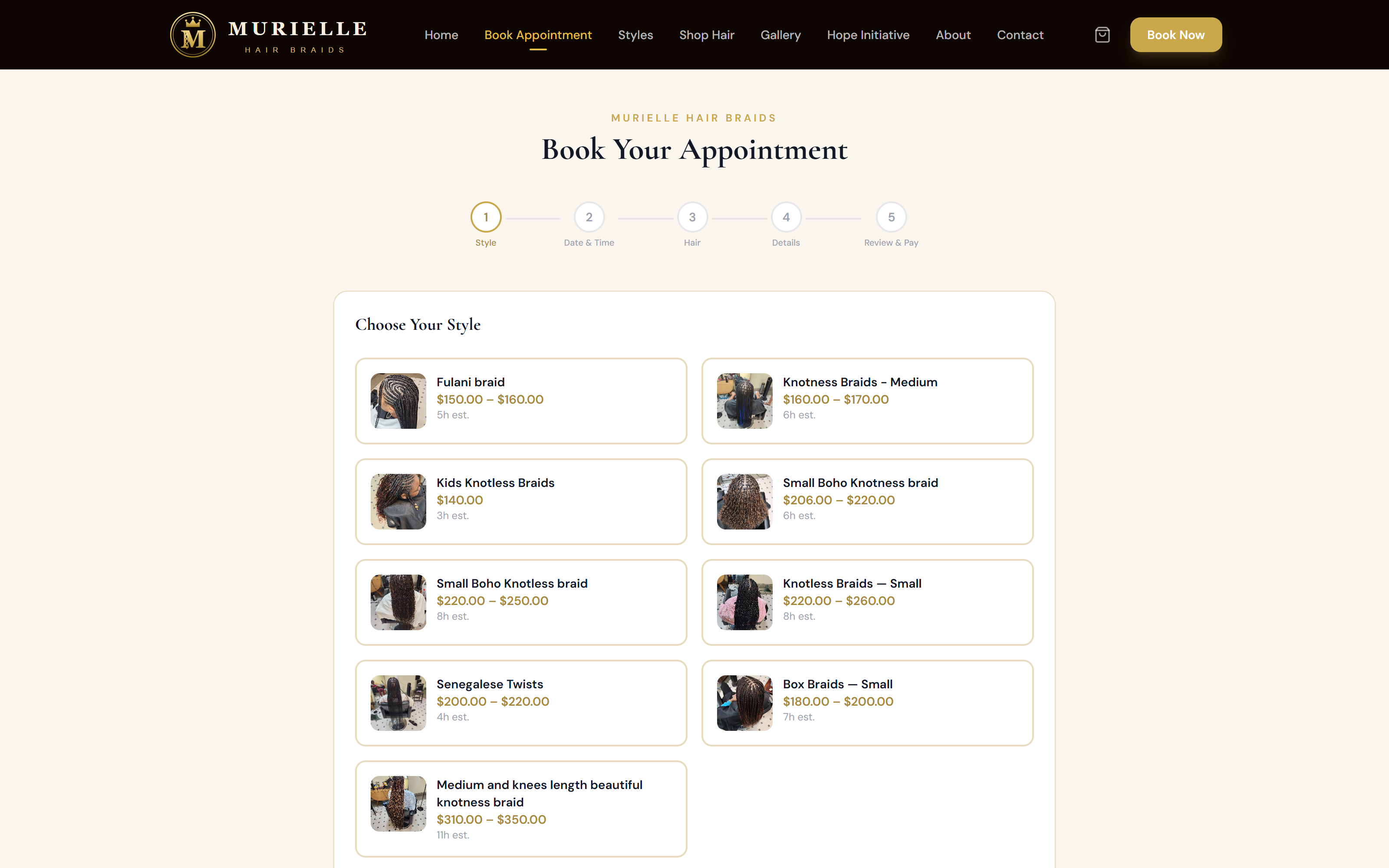
muriellehairbraids.com is a braiding business running a live build. Open it on your phone and walk through it. Pick a style, pick a date, and go as far as the deposit screen — that is the whole flow a customer meets, and there is no better way to judge it than to be the customer for thirty seconds.
On the owner’s side, that booking arrives in a dashboard with the deposit already recorded against it. One place to look, in the morning, to see what the night booked.
Rent your website, or own it
There is a second question hiding under all of this, and it matters more the longer you are in business: when you pay for a website, what do you actually end up holding?
On most subscription platforms, the answer is a licence. The site works while you pay and stops when you stop. The source code is not yours to take. The domain is sometimes registered to the platform rather than to you. Years of paying produce no asset — only a bill that renews.
A website you own means all of it is in your name: the domain, the hosting account, the source code, and every connected account — payments, email, analytics. You can move it, hand it to a different developer, or sell it with the business. That is the difference between an asset and a subscription.
If you would rather set those pieces up yourself, that is a legitimate answer too. The free setup guides walk through claiming the business accounts you should own no matter who builds your site.
What this costs
Sedjro Digital builds a complete business website for $1,500, once. Online booking with deposits, an owner’s dashboard, and mobile-first performance, because that is where your customers are. No monthly fee, no plan, no renewal.
And you own it. The domain, the hosting, the source code and every account are registered to you from day one.
Common questions
Why are my customers coming in less often in 2026?
It is not only happening to you. The Fiserv Small Business Index, which tracks point-of-sale activity at roughly two million U.S. small businesses, recorded a 1.8% year-over-year decline in transactions in August 2026 — the tenth consecutive monthly decline. Over the same period the average ticket rose 3.0%, so customers are still spending. They are consolidating that spending into fewer trips.
Which industries lost the most foot traffic in August 2026?
Services fared worse than goods. Goods and services each grew sales 1.3% year over year, but goods grew on foot traffic, up 0.7%, while services grew entirely on price. Services transactions fell 2.7% and the services average ticket rose 3.9%. If you sell appointments rather than products, you lost visits faster than the average small business.
Should a small service business take deposits for appointments?
A deposit does two useful things. It captures commitment at the moment the customer is most motivated, rather than asking her to remember to call you back. And it means the slot has been paid for regardless of what happens next. It does not guarantee attendance, and you should be sceptical of anyone quoting a precise percentage reduction in no-shows without naming the study behind it.
What is the minimum a service business website should be able to do?
Three things from the customer’s side: show real availability, let her choose a specific service and time, and let her pay something to hold it. And one from yours — the booking has to arrive somewhere you will actually see it, with the payment already attached. A booking notification you miss is a slower version of the missed call.
Do I own my website if I build it on a subscription platform?
Usually not in full. On most subscription platforms you are licensing a site that stops working when you stop paying, and the source code is not portable. Ownership means the domain, the hosting account, the source code and every connected account — payments, email, analytics — are registered in your name, and can be moved, handed to another developer, or sold with the business.
Sources
- Fiserv Small Business Index — August 2026 releasePublished 3 September 2026 · publisher’s own release
- Fiserv Small Business Index — methodology and monthly data~2 million U.S. small businesses · 56 industries · 2019 baseline
More from the journal
- A critical patch shipped last Tuesday. Did it reach your site?WordPress found, fixed and backported a 9.2-severity flaw to 25 releases in one day. The harder question is how a small-business owner would ever know it reached them.
- An AI will recommend a business that does not exist, and sound certainTwo researchers checked every name three AI models recommended against the official register. 4% of the doctors were real — and the invented ones were not random.
- Google is answering your customers without sending them to you68% of US searches now end without a click, and an AI summary halves the rest. What that means if you sell appointments — and why Google says there is no “AI SEO” to buy.
Sedjro Tovihouande is the founder of Sedjro Digital LLC, where he builds booking, e-commerce and automation systems for service businesses. He is pursuing an M.S. in Information Technology — AWS Cloud Technologies at Purdue Global. Live builds include muriellehairbraids.com.